
 About






























 Tibet Tours
 Tibet Train Tours
 Himalaya Tours (Tibet-Nepal-Bhutan)
 Private Tours
 Mount Kailash Tours
 Trekking Tours
 Travel Guide
 Tibet Travel Blog
 FAQ
 About us
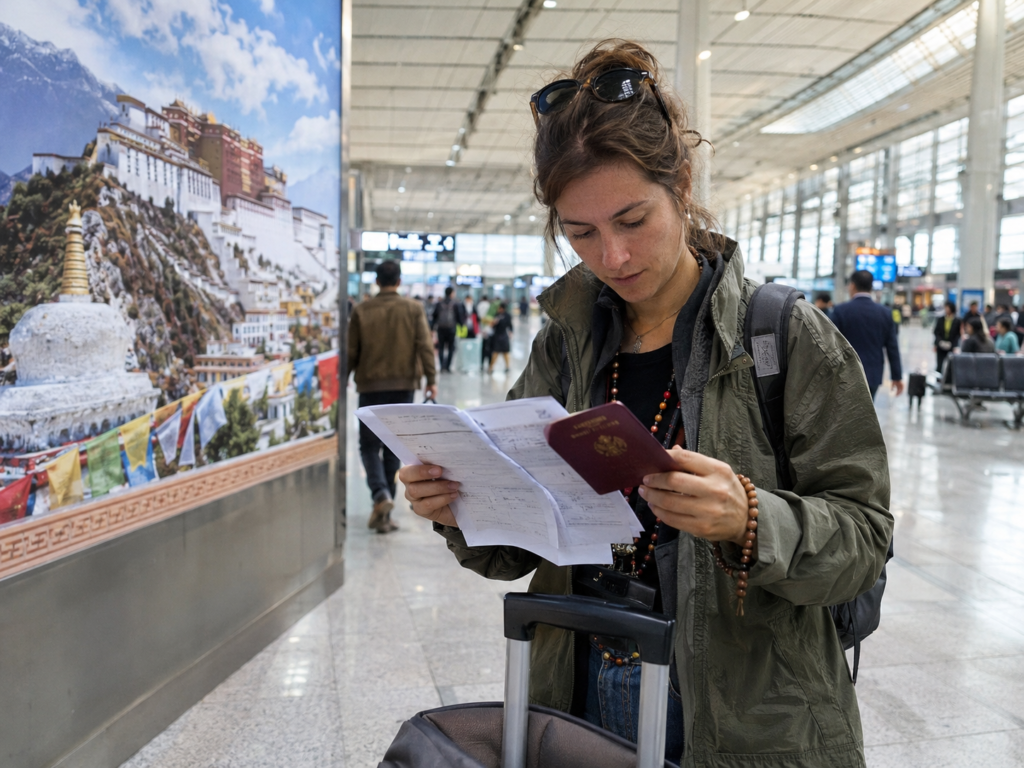
If you’re planning a Tibet trip for spring or summer 2027 from Paris, London, Madrid, Tokyo, Sydney or Toronto, there may be one annoying blank space left in your travel plan:
China visa: to be confirmed.
China’s visa-free policy has made travel much simpler for millions of visitors, but several of the temporary exemptions currently used by European, Australian, Japanese, Canadian and British travelers officially run only until December 31, 2026.
So what happens on January 1?
At the moment, the answer depends on your passport.
Some nationalities already have visa-free access confirmed for 2027 through standing agreements. Russia has a special extension through the end of 2027. Brunei’s unilateral exemption currently has no stated expiry date.
But for another 48 countries, including Spain, France, Germany, the UK, Canada, Australia, Japan and South Korea, China has not yet officially announced a 2027 extension as of November 12, 2026. China’s official consular guidance still lists those exemptions as ending on December 31, 2026.
That doesn’t mean those travelers will definitely need a visa in 2027.
It means we don’t have an official extension yet.
And if Tibet is part of your plans, there is another document to remember anyway: visa-free entry to China does not remove the Tibet Travel Permit requirement.
Let’s sort out what is confirmed, what is still pending, and what you can already book for 2027.
China visa-free 2027: what is officially confirmed right now?
China currently has two main nationwide visa-free systems relevant to ordinary tourists:
- Mutual visa exemption agreements with 29 countries.
- Unilateral visa-free entry for 50 countries under China’s current policy.
These aren’t the same thing.
The mutual agreements are standing agreements between China and another country. The allowed stay and permitted purposes depend on each agreement.
The unilateral policy is China’s own visa waiver. Under the current arrangement, eligible ordinary-passport holders can enter for up to 30 days for tourism, business, visiting family or friends, exchanges or transit.
For travelers planning 2027, the situation currently looks like this:
| Visa-free category | 2027 status as of Nov. 12, 2026 |
|---|---|
| 29 countries with comprehensive mutual visa exemption agreements | Confirmed under existing agreements |
| Brunei | No expiry date currently stated |
| Russia | Confirmed through December 31, 2027 |
| Other 48 countries in China’s unilateral program | Currently confirmed only through December 31, 2026 |
So the big question isn’t whether China currently has a large visa-free program.
It does.
The question is which parts of that program are already guaranteed to continue into 2027.
Which countries are already confirmed visa-free for China in 2027?
There are currently 29 countries covered by comprehensive mutual visa exemption arrangements for ordinary travelers.
China’s official information lists:
Albania, Antigua and Barbuda, Armenia, Azerbaijan, Bahamas, Barbados, Belarus, Bosnia and Herzegovina, Dominica, Ecuador, Fiji, Georgia, Grenada, Kazakhstan, Maldives, Malaysia, Mauritius, Qatar, Samoa, San Marino, Serbia, Seychelles, Solomon Islands, Suriname, Thailand, Tonga, Singapore, United Arab Emirates and Uzbekistan.
These aren’t temporary members of the current European-style unilateral waiver.
They fall under separate mutual agreements.
That means travelers from these countries aren’t waiting for the December 31, 2026 temporary policy deadline in the same way as travelers from France, Spain or Australia.
However, don’t assume every mutual agreement has identical conditions.
The permitted length of stay and purposes of travel are governed by the individual agreement, so check the rules applying to your passport before departure.
Russia is already confirmed visa-free through the end of 2027
Russian travelers have one of the clearest answers.
China officially announced on May 20, 2026 that the visa-free policy for Russian ordinary-passport holders would be extended until December 31, 2027.
Eligible Russian travelers can enter China without a visa for up to 30 days for tourism, business, visits to family or friends, exchanges and transit.
So if you’re a Russian traveler planning Tibet in 2027, the China-entry part of the trip is already considerably clearer.
You still need a Tibet Travel Permit, but you don’t need to figure out the rest of the journey from scratch. Our updated How to Travel from Russia to Tibet in 2027 guide explains the visa-free entry rules, Tibet permits, flight and train options, and routes to Lhasa, Everest Base Camp and Mount Kailash.
Brunei also has visa-free access without a stated expiry date
China’s current official FAQ treats Brunei differently again.
For ordinary Brunei passport holders, the unilateral visa-free policy currently has no stated expiration date.
Russia is listed through December 31, 2027.
The remaining 48 unilateral countries are listed only through December 31, 2026.
That makes Brunei another nationality that can currently plan 2027 without waiting for a temporary-policy extension.
Which countries are still waiting for a 2027 extension?
This is the group that will matter most to many Experience Tibet travelers.
As of November 12, 2026, the following 48 nationalities remain covered by China’s current unilateral visa-free policy only through December 31, 2026:
Europe
France, Germany, Italy, Spain, Netherlands, Switzerland, Ireland, Hungary, Austria, Belgium, Luxembourg, Poland, Portugal, Greece, Cyprus, Slovenia, Slovakia, Norway, Finland, Denmark, Iceland, Andorra, Monaco, Liechtenstein, Bulgaria, Romania, Croatia, Montenegro, North Macedonia, Malta, Estonia, Latvia, Sweden and the United Kingdom.
Oceania
Australia and New Zealand.
Asia
South Korea, Japan, Saudi Arabia, Oman, Kuwait and Bahrain.
Americas
Brazil, Argentina, Chile, Peru, Uruguay and Canada.
China’s official consular FAQ states that these 48 exemptions currently remain valid through December 31, 2026. No general extension into 2027 has been officially announced at the time of this update.
That distinction matters.
If you’re Spanish and traveling to China on December 15, 2026, the current policy is clear.
If you’re traveling on April 15, 2027, don’t simply assume the same rule will apply.
Does this mean Spain, France, Germany, the UK or Australia will need visas in 2027?
We don’t know yet.
And that’s the most accurate answer.
An official policy that expires on December 31, 2026 doesn’t automatically mean China plans to end it.
It also doesn’t automatically renew itself.
China has extended visa-free policies before, but until a new announcement is published, travelers shouldn’t treat a future extension as confirmed.
So if you’re planning Tibet for 2027 from:
- Spain
- France
- Germany
- Italy
- the UK
- Canada
- Australia
- New Zealand
- Japan
- South Korea
- Brazil
- or another country in the temporary group
you can still plan and book the trip.
Just leave the China visa question open until the policy applying to your actual travel date is confirmed.
Our How to Book a Tibet Tour for 2027 guide explains how departure dates, deposits and permit preparation fit together when some travel documents aren’t available yet.
Can you book a Tibet tour for 2027 before knowing whether you need a China visa?
Yes.
Your China visa situation and your Tibet tour booking aren’t the same step.
You can choose a Tibet route, select a departure and start planning your trip before a future China visa policy is finalized.
Experience Tibet already has scheduled departures extending into 2027, as well as private tours with flexible requested dates.
Start by browsing the current Tibet Tour Packages.
Once the China entry policy for your nationality and travel date is confirmed, you’ll know whether you need:
- a standard Chinese visa; or
- qualifying visa-free entry.
Then Experience Tibet can use the relevant documentation when preparing the Tibet Travel Permit arrangements for your confirmed itinerary.
If you’re working with a fixed travel budget, our Best Tibet Tours by Budget: Under $1,000, $1,500 and $2,500 can also help narrow down the route before dealing with the paperwork.
Visa-free China still does not mean permit-free Tibet
This is the part that shouldn’t get lost in all the visa news.
Suppose you’re from Russia.
You enter China visa-free in 2027.
You still need a Tibet Travel Permit before traveling to Lhasa.
The same applies if you’re from Singapore, Thailand, Malaysia, Kazakhstan, the UAE or another country covered by a standing visa-exemption agreement.
And it would still apply to a French, Spanish or Australian traveler if their unilateral visa exemption is extended into 2027.
Foreign passport holders visiting the Tibet Autonomous Region need the Tibet-specific travel arrangements required for their itinerary. Visa-free China entry changes the China visa step. It doesn’t cancel the Tibet permit process.
For a straightforward explanation of the difference, read Do You Need a Tibet Visa or Tibet Permit?.
What documents does a visa-free traveler need for a Tibet Travel Permit?
The exact document request depends on your nationality and China entry status.
For travelers who need a standard China visa, the permit process normally requires the relevant passport and China visa information.
If your nationality qualifies for visa-free entry at the time of travel, you won’t suddenly need to obtain an unnecessary tourist visa just to have something to attach to the Tibet application.
Instead, the agency works with the documentation relevant to your legal China entry status.
The key point is that your Tibet itinerary must be confirmed first, because the permit application is tied to the places you’re visiting.
A four-day Lhasa trip doesn’t involve exactly the same permit setup as a trip to Everest or Mount Kailash.
You can read the route-by-route differences in Types of Permits for Tibet.
When you’re ready to provide your travel information, Experience Tibet also has a Tibet Travel Permit request and application page.
What about the 240-hour visa-free transit policy?
Don’t confuse China’s 30-day visa-free entry with its 240-hour visa-free transit policy.
They solve different problems.
The 30-day visa-free policy allows qualifying ordinary-passport holders to visit China for permitted purposes without first arranging a visa.
The 240-hour policy is a transit scheme. You need an onward journey to a third country or region, and you’re restricted to the areas authorized under that policy.
Tibet is not included among the permitted stay areas of the 240-hour transit system.
So don’t design a Tibet trip around:
“I’ll enter China on the 240-hour transit exemption and then fly to Lhasa.”
That isn’t what the policy allows.
For a normal Tibet trip, you need a China entry status that works for the actual journey you’re taking, plus the appropriate Tibet permits.
Which Tibet tours make sense for visa-free travelers in 2027?
The visa policy doesn’t limit you to a particular Tibet tour.
Once your China entry status and Tibet permits are in order, your decision should be about time, route and budget.
First Tibet trip: 4 days in Lhasa
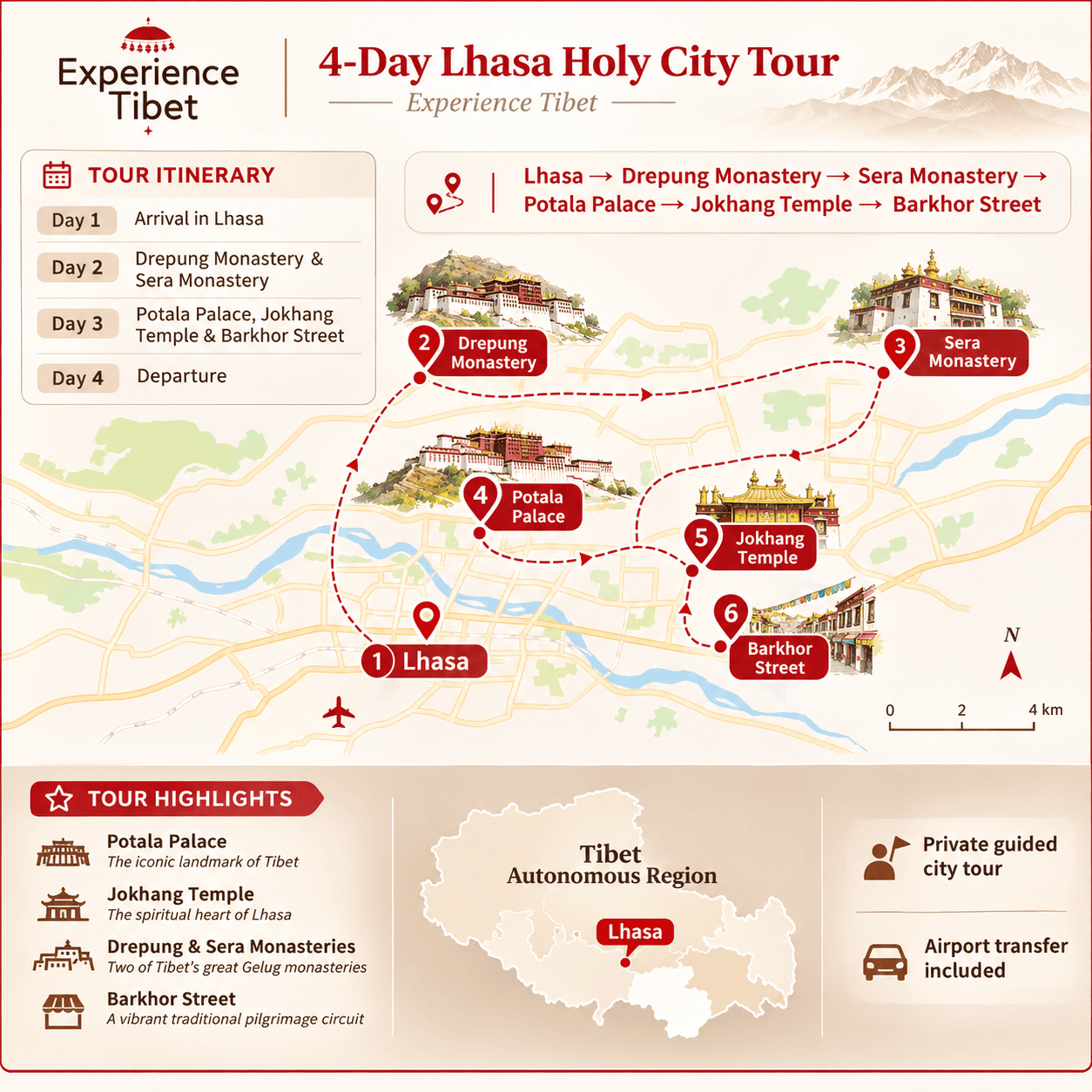
The 4-Day Lhasa Holy City Tour is the simplest starting point.
It covers Potala Palace, Jokhang Temple, Barkhor Street, Drepung and Sera without adding long overland journeys.
It’s particularly easy to combine with a wider China trip if you’re already visiting Beijing, Shanghai or Chengdu.
Everest: 8 days from Lhasa
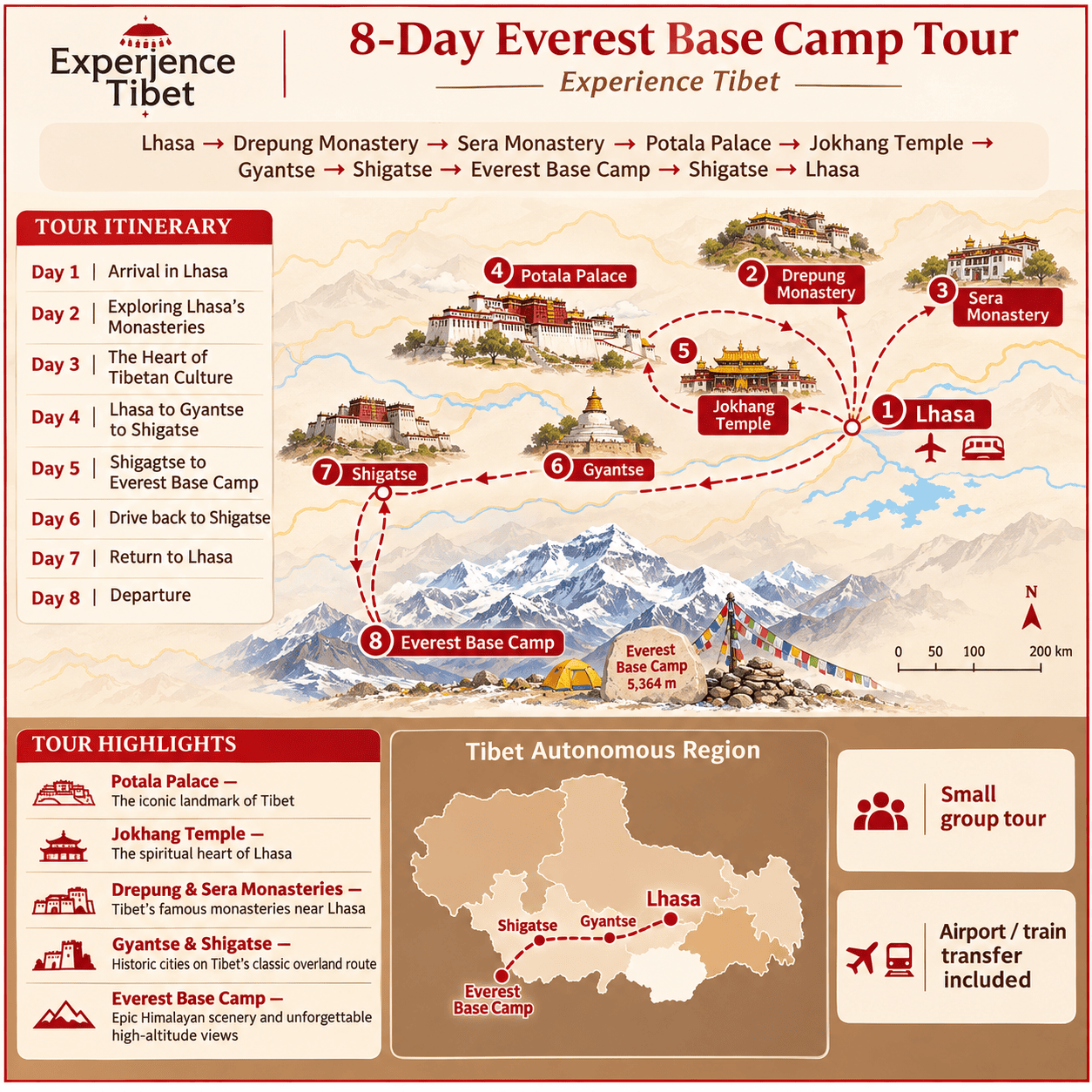
If you’re coming to Tibet specifically for the Himalayas, the 8-Day Everest Base Camp Tour continues from Lhasa through Yamdrok Lake, Gyantse and Shigatse to the north side of Everest.
Permit requirements are more involved than a Lhasa-only route, but Experience Tibet handles the permit arrangements connected with the booked itinerary.
Combine mainland China and Tibet by train
If your 2027 China entry rules allow visa-free travel, it can also make a longer China itinerary easier to organize.
Experience Tibet offers Tibet Train Tours starting from Beijing/Xi’an, Chengdu, Shanghai and Xining.
That lets you combine time in mainland China with the Qinghai-Tibet Railway and a Tibet itinerary.
Want your own dates?
If you’re planning around specific flights, an anniversary or a longer China trip, Private Tibet Tours allow flexible requested departure dates and customized itineraries.
Should you wait for the visa announcement before booking flights?
For the 48 temporary visa-free countries, I’d separate tour planning from non-refundable international travel.
Choosing your Tibet route now makes sense.
Checking 2027 group departures now makes sense.
Requesting a private itinerary now also makes sense.
But if your plan depends entirely on entering China visa-free in March or April 2027, don’t treat the current 2026 exemption as proof that you’ll have the same status next year.
Either wait for the official policy update or make sure your flight arrangements still work if you need to apply for a Chinese visa.
The paperwork isn’t particularly romantic, but finding out at airport check-in is worse.
What if China doesn’t extend my country’s visa-free policy?
Your Tibet trip doesn’t automatically disappear.
It just means you’ll need to follow the normal Chinese visa process applicable to your nationality before the Tibet permit arrangements are completed.
For most travelers, the journey would then follow this order:
- Choose and confirm the Tibet itinerary.
- Apply for the appropriate China visa when required.
- Provide the requested passport and China-entry documents to Experience Tibet.
- Experience Tibet prepares the Tibet permit application for the confirmed route.
- Complete final travel arrangements and travel to Tibet.
So the visa-free policy removes one piece of administration when it applies.
It isn’t what makes a Tibet tour possible in the first place.
Frequently asked questions about China visa-free travel in 2027
Which countries are definitely visa-free for China in 2027?
As of November 12, 2026, China has comprehensive mutual visa exemption agreements with 29 countries. Brunei’s unilateral visa waiver has no stated expiry date, while Russia’s current waiver is confirmed through December 31, 2027.
Is Spain visa-free for China in 2027?
Not yet officially confirmed.
Spanish ordinary-passport holders currently qualify for China’s unilateral 30-day visa-free policy through December 31, 2026. A general 2027 extension has not been announced as of November 12, 2026.
Is France visa-free for China in 2027?
France is currently covered through December 31, 2026. A 2027 continuation has not yet been officially confirmed.
Is the UK visa-free for China in 2027?
The UK joined China’s unilateral visa-free scheme on February 17, 2026, but the current official policy runs through December 31, 2026.
Is Canada visa-free for China in 2027?
Canada follows the same current timeline as the UK: its unilateral visa-free access is presently confirmed through December 31, 2026, not yet through 2027.
Is Russia visa-free for China in 2027?
Yes. China’s Foreign Ministry confirmed that Russian ordinary-passport holders can use the current visa-free policy through December 31, 2027, for eligible stays of up to 30 days.
Do visa-free travelers need a Tibet Travel Permit in 2027?
Yes.
China visa exemption and the Tibet Travel Permit are separate issues. Foreign travelers still need the Tibet-specific permit arrangements required for their route.
Can I apply for the Tibet Travel Permit before the 2027 visa policy is confirmed?
You can start planning and book your Tibet itinerary, but the permit process needs the documents relevant to your actual China entry status.
Experience Tibet will tell you what to provide once the policy applying to your nationality and travel date is clear.
Planning Tibet for 2027? Don’t let an unconfirmed visa rule stop the whole trip
If your passport already falls under one of China’s standing mutual visa exemption agreements, you have a much clearer starting point for 2027.
If you’re Russian, your current exemption is confirmed through the end of 2027.
If you’re from one of the 48 countries whose temporary unilateral waiver ends on December 31, 2026, there’s no need to cancel your plans or pretend an extension has already happened.
Plan the route.
Choose the dates.
Then check the visa rule again before committing to the parts of the trip that depend on it.
And whichever China entry rule applies to you, remember the second half of the equation:
foreign travelers still need a Tibet Travel Permit for Tibet.
Experience Tibet has more than 15 years of experience arranging Tibet trips with local guides and helping travelers prepare the permits connected with their booked itineraries.
Browse Tibet Tours for 2027 or read How to Book a Tibet Tour for 2027 before choosing your departure.
Already planning Tibet for 2027? Send us your nationality, preferred dates and the places you want to visit. We’ll confirm the Tibet tour options and tell you what China-entry and Tibet permit documents apply once the rules for your travel date are confirmed.