Some journeys don’t just take you to new places. They take you to entirely different worlds.
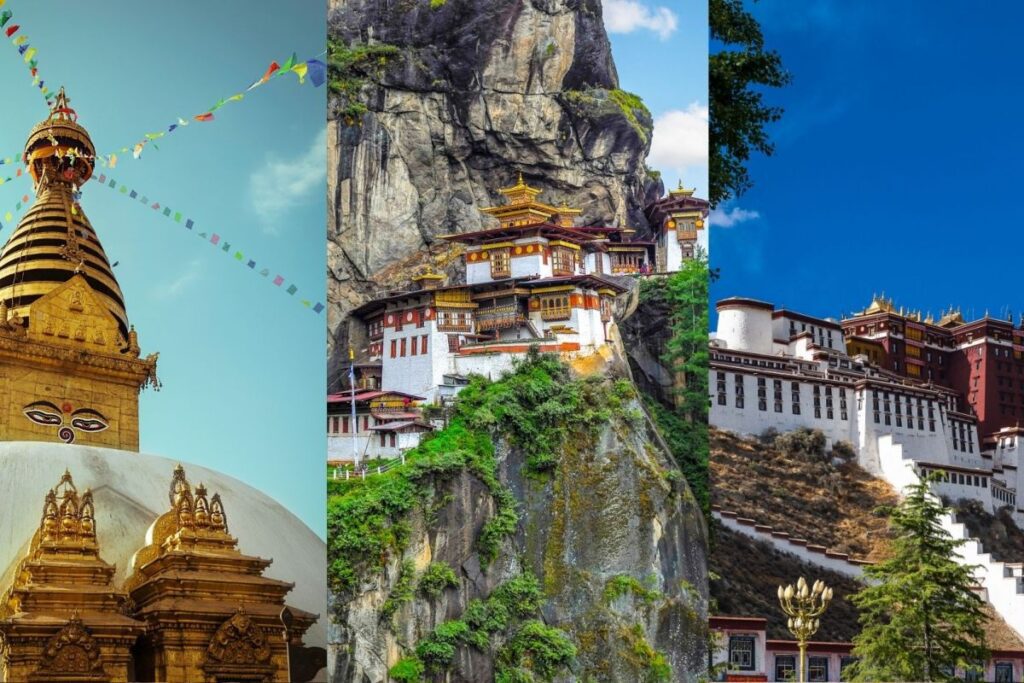
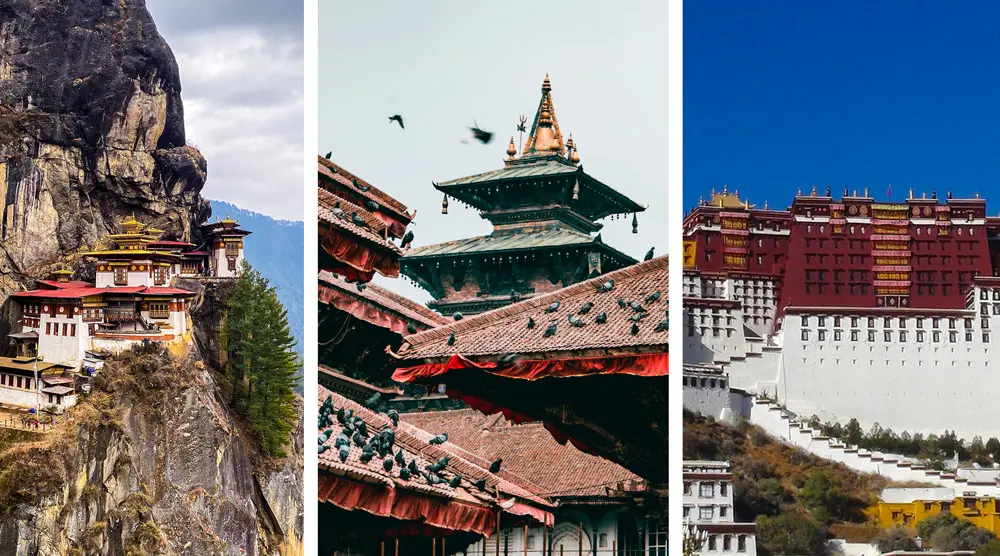
A Tibet, Nepal and Bhutan tour does exactly that — three kingdoms, three distinct civilizations, and one shared spine of mountains that has defined human spiritual life for millennia. In a single journey, you can stand before the golden rooftops of Lhasa’s Potala Palace at 3,650 meters, cross overland through the Himalayas into Nepal’s Kathmandu Valley, and hike to Tiger’s Nest Monastery in Bhutan, a temple so dramatically perched on a cliff face that it looks like it was placed there by someone with no respect whatsoever for the laws of physics.
This is not the easiest trip in Asia. But it is, for many travelers, the most unforgettable one.
This guide tells you exactly how to plan it — from permit logistics to choosing the right itinerary length, with verified tour options at every level of ambition and budget.
Why Combine Tibet, Nepal and Bhutan in One Trip?
The practical answer: geography makes it remarkably logical. Tibet, Nepal and Bhutan all sit along the same Himalayan chain , which means that traveling between them overland is not only possible — it’s one of the great adventure routes on Earth.
But the deeper answer is about contrast and completeness.
Tibet
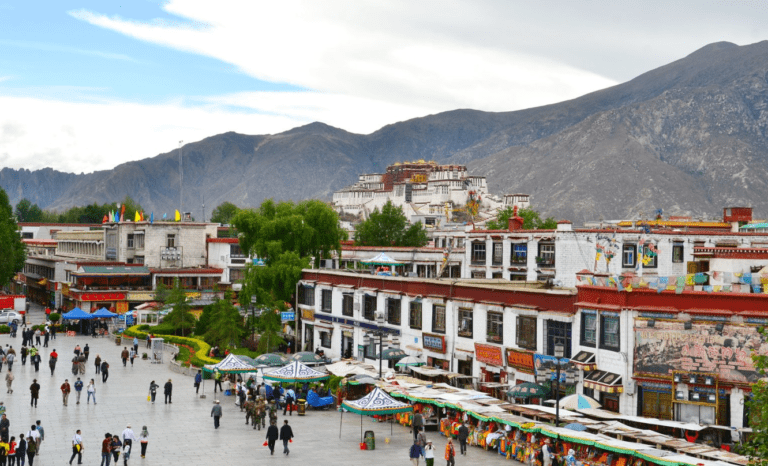
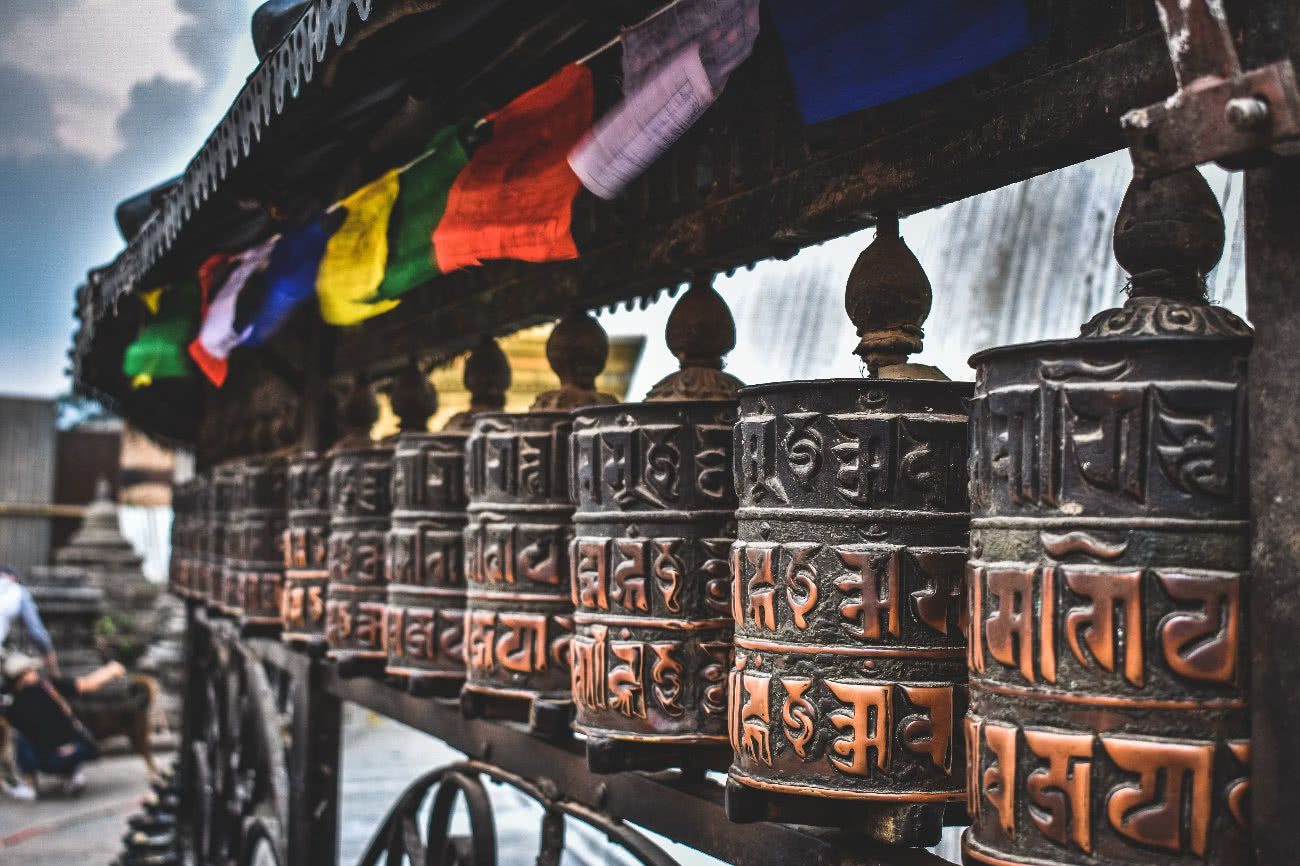
is Buddhism distilled to its purest, most austere form — monasteries perched above clouds, monks in burgundy robes, the sound of prayer wheels turning on streets that haven’t changed in centuries. It is remote, otherworldly, and profoundly moving in a way that’s very hard to explain until you’re standing in Barkhor Square watching pilgrims complete their dawn koras around the Jokhang Temple.
Nepal
is the counterpoint — chaotic, colorful, and electrically alive. The Hindu temples of Kathmandu, the jungle safaris of Chitwan, the impossibly beautiful lake city of Pokhara with the Annapurna Range reflected in its water at dawn. Nepal is where the Himalayas meet humanity at full volume.
Bhutan
is something else entirely — a Himalayan kingdom that has managed to preserve its culture, forests, and spiritual life with an intentionality that feels almost miraculous. A country where Gross National Happiness is an official government policy, where Tiger’s Nest Monastery clings to a 3,000-meter cliff, and where the number of tourists is deliberately limited to protect what makes it extraordinary.
Together, they form what many experienced travelers call the most complete Himalayan experience possible — three faces of the same mountain range, three expressions of the same spiritual geography.
Who is this trip for?
- Travelers who want depth over breadth — preferring one extraordinary region thoroughly to skimming five countries
- Anyone who finds the Himalayas calling — whether for spiritual, cultural, or adventure reasons
- First-time visitors to the region who want an expertly guided, fully organized experience
- Experienced Asia travelers ready for their most ambitious itinerary yet
Tibet Nepal Bhutan Tour Options: 3 Itineraries by Duration
Experience Tibet offers flexible options depending on your time and focus. Here are the three main configurations — all verified and bookable:
Option 1: Tibet + Nepal — 7 to 8 Days (The Focused Version)
Best for: Travelers with limited time who want to combine the two most connected Himalayan destinations without Bhutan. Also perfect as a standalone trip that can be extended later.
Two directions available:
Tibet → Nepal (7 Days): Lhasa to Kathmandu Overland
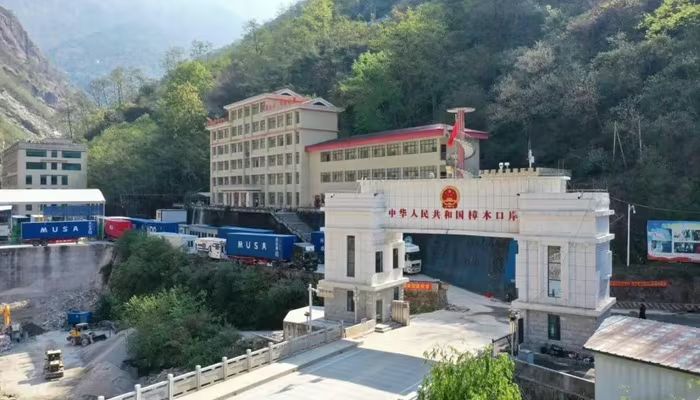
Start in Lhasa, cross the Tibetan plateau, and descend into Nepal through the spectacular Kyirong Valley.
Route: Lhasa → Tibetan Plateau → Kyirong Valley → Cross Tibet-Nepal border → Kathmandu
Key stops: Lhasa’s monasteries and Potala Palace → Yamdrok Lake → Shigatse → Tingri → North Everest Base Camp → Kyirong border → Kathmandu
💛 Book: 7-Day Tibet to Nepal Overland Tour — From Lhasa to the Himalayas
Nepal → Tibet (8 Days): Kathmandu to Lhasa Overland
The reverse direction — starting in Kathmandu and gradually ascending through the Himalayas into Tibet. This route offers the advantage of gradual altitude acclimatization.
Route: Kathmandu → Nepal-China Border → Kyirong → Everest Base Camp → Tingri → Shigatse → Gyantse → Yamdrok Lake → Lhasa
Why choose the overland route from Nepal? You see more of Tibet’s landscapes, including the Everest region, high passes, and turquoise lakes. You gradually gain altitude with acclimatization stops — reducing the risk of altitude sickness compared with flying directly into Lhasa. And you experience both Tibet and Nepal in one continuous journey.
💛 Book: 8-Day Himalayan Tour from Nepal to Tibet (Lhasa)
Option 2: Tibet + Nepal (Extended) — 12 Days (The Classic)
Best for: Travelers who want the cultural depth of Lhasa PLUS a full Nepal experience — including Kathmandu, Chitwan National Park, and Pokhara — without the full 16-day commitment.
How to build this itinerary:
Module 1 — Tibet (4 days): The 4-Day Lhasa Holy City Tour (from US$486) takes you through the commanding views of Potala Palace, the ancient and secretive Jokhang Temple, and the highlights of Drepung and Sera Monasteries. Small groups of 4–13 participants, 3 nights in premium 3/4-star hotels, Tibet Travel Permit handled.
Module 2 — Nepal (8 days): 8-Day Nepal Tour: Journey through Kathmandu, Chitwan and Pokhara
The Nepal tour ends with a transfer to Tribhuvan International Airport in Kathmandu for departure.
Combined highlights:
| Days | Location | Experience |
|---|---|---|
| Days 1–4 | Lhasa, Tibet | Potala Palace · Jokhang Temple · Barkhor Street · Drepung & Sera Monasteries |
| Days 5–6 | Kathmandu | Boudhanath Stupa · Pashupatinath Temple · Durbar Square |
| Days 7–8 | Chitwan | Jungle safari · wildlife · traditional Tharu culture |
| Days 9–10 | Pokhara | Phewa Lake · Annapurna Range · Sarangkot sunrise |
| Days 11–12 | Return Kathmandu | Departure |
💛 Book the modules separately:
Option 3: Tibet + Nepal + Bhutan — 16 Days (The Grand Trans-Himalayan)
Best for: Travelers who want the complete experience — all three kingdoms, one extraordinary journey. This is Experience Tibet’s flagship multi-country tour and the most comprehensive Tibet Nepal Bhutan tour package available.
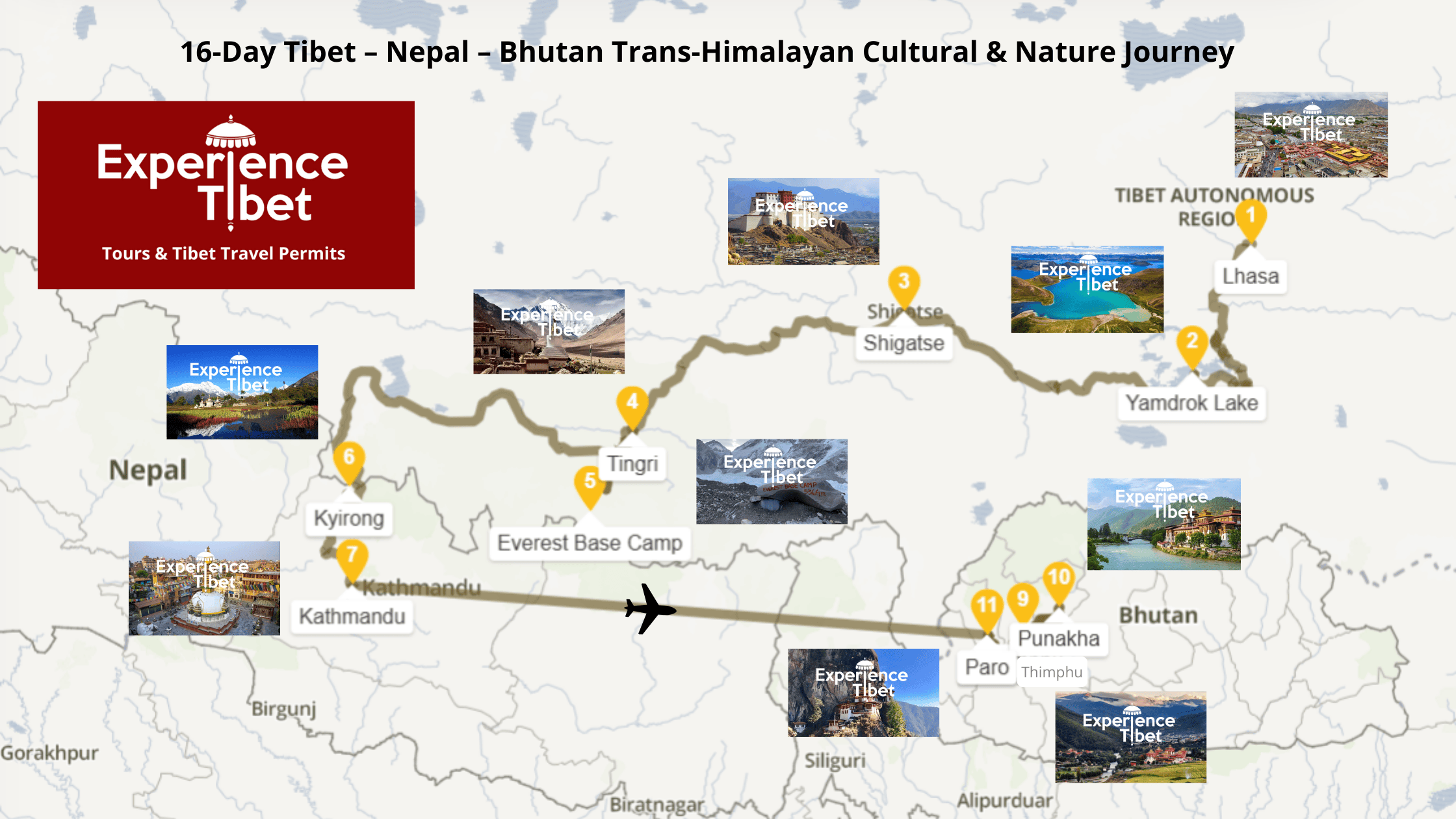
The 16-Day Tibet, Nepal & Bhutan Trans-Himalayan Tour is a Trans-Himalayan journey from Lhasa and Everest to Kathmandu, Paro, Thimphu and Punakha.
Begin in Lhasa, exploring Drepung and Sera Monasteries, the Potala Palace, Jokhang Temple and the Barkhor pilgrimage circuit, with time to acclimatize at high altitude. Cross the Tibetan plateau via the turquoise shores of Yamdrok Lake and historic Shigatse before travelling on to Tingri and North Everest Base Camp, where you can enjoy close-up views of Mount Everest and a spectacular Himalayan sunrise (weather permitting). Descend through the greener Kyirong Valley and cross into Nepal, continuing through river gorges and terraced hillsides to Kathmandu.
From Nepal, the journey continues into Bhutan — the final, jewel-like chapter of this Trans-Himalayan odyssey.
Day-by-day overview:
| Days | Location | Highlights |
|---|---|---|
| Days 1–2 | Lhasa | Arrival · Acclimatization · Drepung & Sera Monasteries |
| Days 3–4 | Lhasa | Potala Palace · Jokhang Temple · Barkhor Street |
| Day 5 | Lhasa → Shigatse | Yamdrok Lake · Karo-la Glacier · Tashilhunpo Monastery |
| Day 6 | Shigatse → EBC area | Tingri · Rongbuk Monastery approach |
| Day 7 | Everest Base Camp | North EBC · Himalayan sunrise (weather permitting) |
| Day 8 | EBC → Kyirong | Descent through Kyirong Valley |
| Day 9 | Kyirong → Kathmandu | Border crossing · arrival in Nepal |
| Days 10–11 | Kathmandu | Kathmandu cultural treasures · Boudhanath · Pashupatinath |
| Days 12–13 | Paro & Thimphu, Bhutan | Arrival · Thimphu Dzong · Buddha Dordenma |
| Day 14 | Paro, Bhutan | Tiger’s Nest Monastery (Taktsang), perched dramatically on a cliff face · Kyichu Lhakhang, one of Bhutan’s oldest and most sacred temples |
| Day 15 | Punakha | Punakha Dzong · local nunnery |
| Day 16 | Departure Paro | Farewell dinner · departure from Paro International Airport |
Price: From US$3,270 per person
What’s included: Tibet Travel Permit · English-speaking guides · 3-star accommodation with breakfast · ground transportation including Kyirong-Kathmandu transfer · Everest eco-bus · welcome dinners in Tibet and Nepal · travel insurance · oxygen supply · Bhutan visa fee (40perperson)⋅BhutanSustainableDevelopmentFee/SDF(40 per person) · Bhutan Sustainable Development Fee / SDF (40perperson)⋅BhutanSustainableDevelopmentFee/SDF(100 per person)
Not included: Flights or trains to and from Tibet · additional meals not specified in the itinerary · single room supplement · tips (recommended: $7 per day per person, shared between driver and guide)
💛 Book: 16-Day Tibet, Nepal & Bhutan Trans-Himalayan Tour — from US$3,270
What You’ll Experience in Each Destination
🏔️ Tibet — The Roof of the World
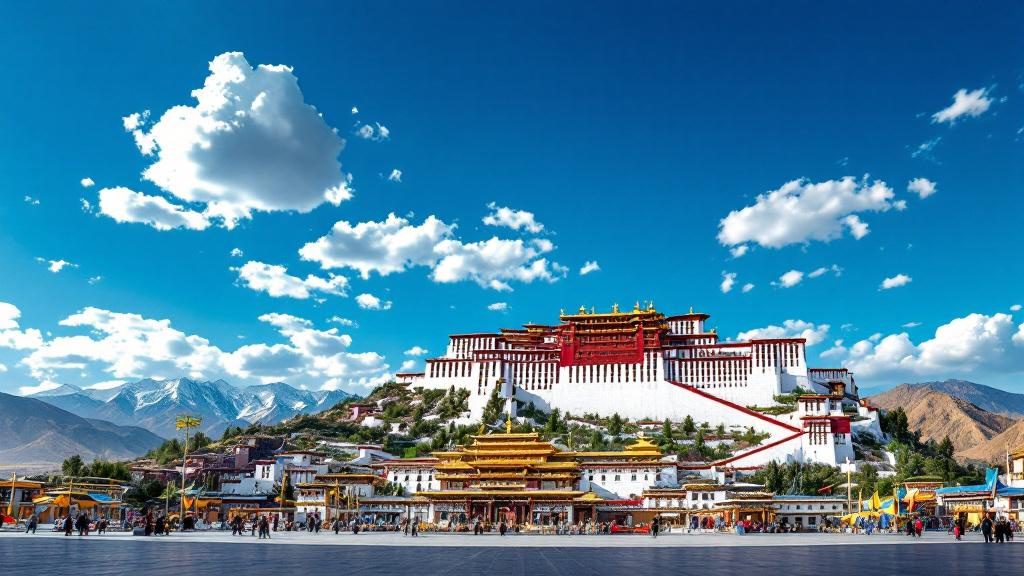
Tibet is the starting point for all three itinerary options — and for good reason. It’s the most logistically complex part of the journey (requiring a special permit beyond your China visa), and its high altitude demands acclimatization time that works best at the beginning of a trip.
Lhasa sits at 3,650 meters above sea level. Your first day is always for rest and acclimatization — not weakness, but wisdom. By day two, you’re ready for what awaits.
The 4-Day Lhasa Holy City Tour is perfect for sampling this extraordinary culture, exploring its main sites, and witnessing the colorful customs and people. Lhasa City is the heartbeat of the Tibetan people and nowhere else can you experience the spirit of the people and the land.
Key sites in Tibet:
- Potala Palace — 13 stories, 1,000 rooms, the iconic winter residence of the Dalai Lamas and the visual symbol of Tibet
- Jokhang Temple — the holiest shrine in Tibetan Buddhism, surrounded by pilgrims completing prostrations at all hours of the day
- Barkhor Street — the ancient pilgrimage circuit around the Jokhang, lined with market stalls, incense smoke, and centuries of devotion
- Drepung & Sera Monasteries — the great monastic universities of Lhasa, home to debating monks and living Buddhist traditions
- Yamdrok Lake — a sacred turquoise lake at 4,400 meters, one of Tibet’s most breathtaking landscapes
- North Everest Base Camp — the Tibetan side of the world’s highest mountain, with fewer crowds and arguably more dramatic views than the Nepali south face.
🕌 Nepal — The Himalayan Crossroads
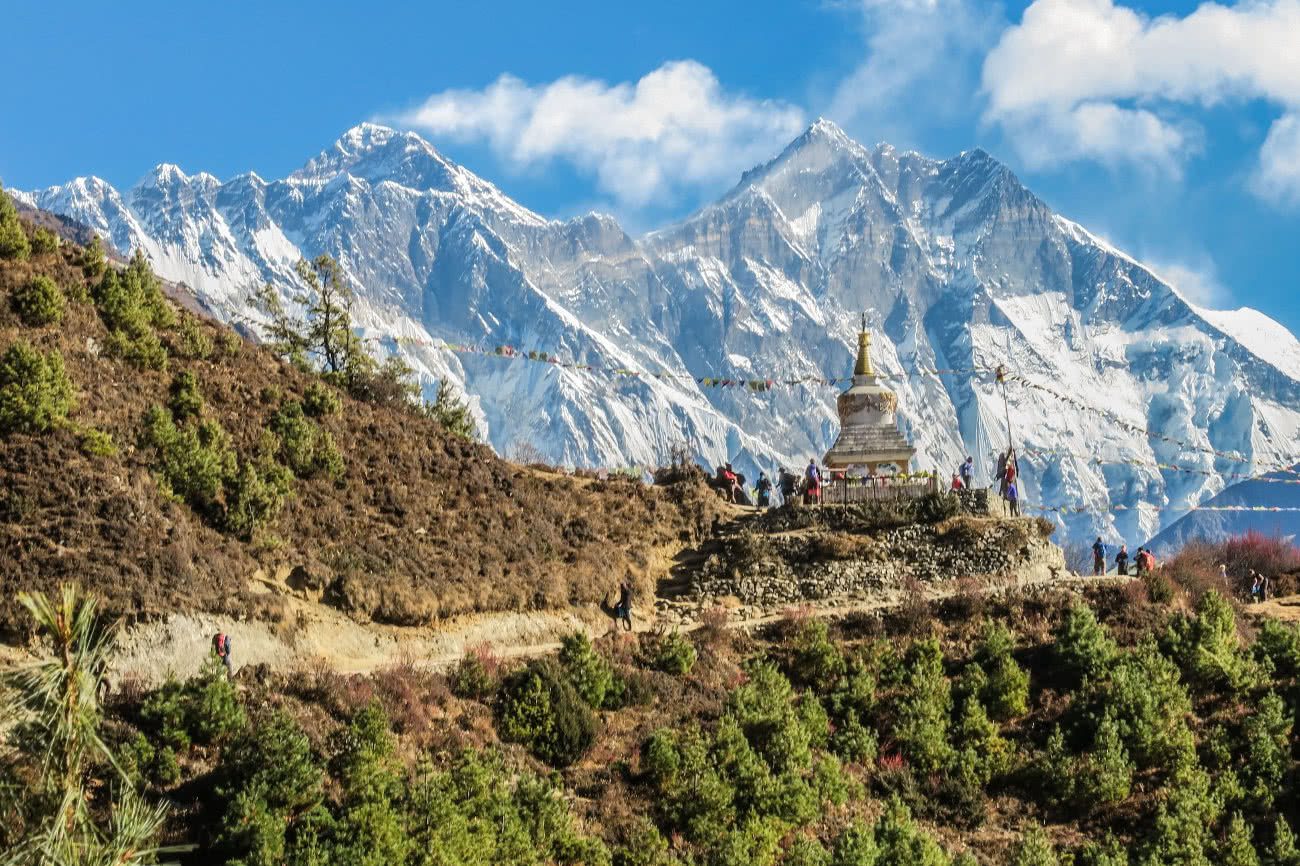
Nepal is where the Himalayas meet the world. After the austere, high-altitude landscapes of Tibet, Kathmandu feels almost overwhelmingly alive — temples at every corner, incense in the air, the chaos of a city that has been a crossroads of Himalayan civilization for over 2,000 years.
Key experiences in Nepal:
- Boudhanath Stupa — one of the largest stupas in the world, surrounded by Tibetan Buddhist monasteries; a spiritual continuity with Lhasa that feels deeply meaningful after crossing the border
- Pashupatinath Temple — the sacred Hindu cremation ghats on the Bagmati River; one of the most powerful and moving sites in all of Asia
- Kathmandu Durbar Square — ancient royal palaces and living goddess temples in the heart of the old city
- Chitwan National Park — jungle safaris in search of one-horned rhinos, Bengal tigers, and elephants; a dramatic change of scenery from the plateau
- Pokhara & Phewa Lake — the Annapurna Range reflected in mirror-calm water at sunrise; one of the most photographed views in Nepal.
🐉 Bhutan — The Last Himalayan Kingdom
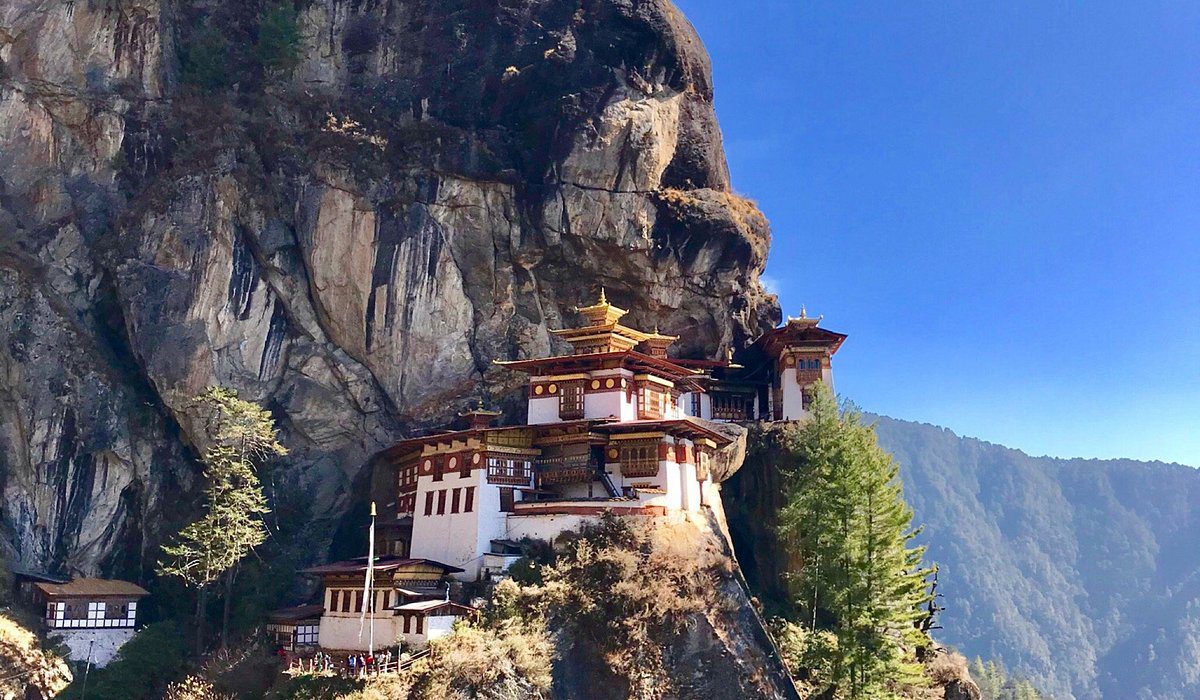
Bhutan is deliberately unhurried. The country limits tourist numbers, charges a daily fee to fund sustainable tourism, and has managed to protect more than 70% of its land as forest. The result is a kingdom that feels genuinely different from anywhere else — clean, quiet, deeply Buddhist, and almost achingly beautiful.
Tiger’s Nest Monastery (Taktsang), perched dramatically on a cliff face at 3,120 meters, is the defining image of Bhutan — a two-hour hike that ends with one of the most spectacular viewpoints in Asia. Kyichu Lhakhang, one of Bhutan’s oldest and most sacred temples , dates to the 7th century.
Beyond Paro, the capital Thimphu offers the giant Buddha Dordenma statue overlooking the Thimphu Valley, fortress-monasteries (dzongs) that double as administrative centers, and a culture that has managed to modernize without losing its soul.
Punakha Dzong — the winter capital of Bhutan’s monastic body — sits at the confluence of two rivers and is widely considered the most beautiful dzong in the country.
💡 Important: The Bhutan Sustainable Development Fee (SDF) of $100 per person is included in the 16-Day Trans-Himalayan Tour price. This fee funds Bhutan’s conservation and cultural preservation programs.
Permits You Need for a Tibet Nepal Bhutan Tour
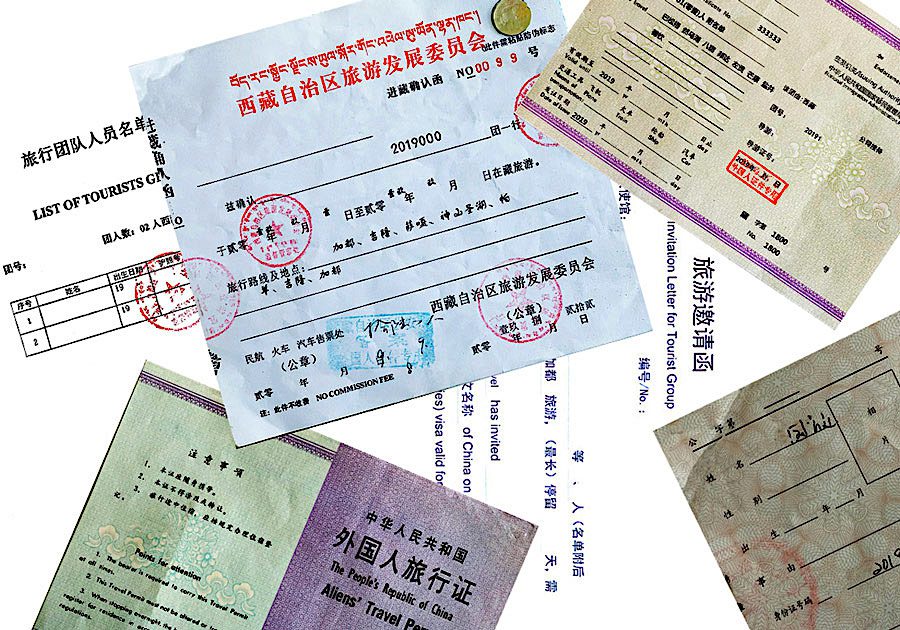
This is where most travelers feel overwhelmed — and where Experience Tibet’s 15+ years of expertise makes the biggest difference.
📋 Tibet Travel Permit — Essential, Non-Negotiable
All foreign travelers visiting Tibet must obtain the Tibet Travel Permit in addition to their standard China visa (or eligible visa exemption). Entry without the permit is strictly prohibited.
The permit is issued by the Tibet Tourism Bureau and cannot be obtained by individual travelers — it must be applied for through an authorized Tibet travel agency. Experience Tibet is authorized to prepare and submit your Tibet Travel Permit application directly to the Tibet Tourism Bureau.
Documents required: Passport scan (bio page) + Chinese visa scan if applicable. These are mandatory for the official Tibet Travel Permit application.
How you’ll receive it:
- If you fly or take the train to Lhasa: Experience Tibet sends you a digital copy to print for boarding, and your guide holds the original permit at Lhasa Airport.
- If you enter overland from Nepal via the Gyirong Border: your guide holds the original permit and waits for you at the Gyirong border.
How far in advance to apply: It is recommended to apply at least 15–20 days before your planned travel date to ensure ample processing time.
💛 Apply online: Tibet Travel Permit Online Application 2026 — Submit Your Request
📋 Nepal Visa
Most nationalities can obtain a Nepal tourist visa on arrival at Tribhuvan International Airport in Kathmandu, or at the Gyirong-Rasuwa border crossing when entering from Tibet. Fees and requirements vary by nationality — verify current rules with the Nepal Immigration Department or contact Experience Tibet for guidance.
📋 Bhutan Visa + Sustainable Development Fee (SDF)
Bhutan does not issue visas on arrival. All visas must be arranged in advance through a licensed Bhutanese tour operator or international partner agency — which is exactly what Experience Tibet handles on your behalf.
The Bhutan visa fee (40perperson)andtheBhutanSustainableDevelopmentFee(40 per person) and the Bhutan Sustainable Development Fee (40perperson)andtheBhutanSustainableDevelopmentFee(100 per person) are both included in the 16-Day Tibet, Nepal & Bhutan Trans-Himalayan Tour price.
Quick Permits Reference Table
| Destination | Permit/Visa | Required by | Handled by Experience Tibet? |
|---|---|---|---|
| Tibet | Tibet Travel Permit + China visa/exemption | All foreign visitors | ✅ Yes — all tour packages |
| Nepal | Tourist visa (on arrival for most) | All foreign visitors | ✅ Guidance provided |
| Bhutan | Bhutan visa + SDF ($140 total) | All visitors | ✅ Yes — included in 16-Day Tour |
Best Time for a Tibet Nepal Bhutan Tour
All three destinations share a broadly similar seasonal pattern, driven by the Himalayan monsoon:
| Season | Tibet | Nepal | Bhutan | Overall Rating |
|---|---|---|---|---|
| 🌸 Spring (Apr–May) | ✅ Clear skies, moderate cold | ✅ Excellent — rhododendrons | ✅ Excellent — festivals | ⭐⭐⭐⭐⭐ |
| ☀️ Early Summer (Jun) | ⚠️ Monsoon beginning | ⚠️ Monsoon | ⚠️ Monsoon begins | ⭐⭐ |
| 🌧️ Monsoon (Jul–Aug) | ⚠️ Plateau drier but roads difficult | ❌ Heavy rain | ❌ Heavy rain | ⭐ |
| 🍂 Autumn (Sep–Nov) | ✅ Best visibility — EBC views spectacular | ✅ Best trekking season | ✅ Excellent — festivals | ⭐⭐⭐⭐⭐ |
| ❄️ Winter (Dec–Feb) | ❌ Very cold, some routes close | ⚠️ Cool but possible | ⚠️ Cold, some dzongs less accessible | ⭐⭐ |
The two golden windows for a Tibet Nepal Bhutan tour:
April to May — Spring is exceptional. Tibet’s plateau begins to warm, Nepal’s rhododendron forests are in full bloom, and Bhutan celebrates some of its most important tsechu festivals. Everest Base Camp views are typically clear and the Kyirong Valley road is fully open.
September to October — Autumn is arguably the single best season. The monsoon has cleared the air, visibility across the Himalayas is at its peak, Nepal’s trekking routes are at their best, and temperatures in all three countries are comfortable for sightseeing and walking.
⚠️ Important for Tibet: Tibet may close to foreign tourists during certain periods, typically around politically sensitive dates in early spring. The best time to visit Tibet is from April to October, when the weather is most favorable with clearer skies and milder temperatures. Experience Tibet’s team confirms exact availability for your specific travel dates at the time of booking.
How Long Should Your Tibet Nepal Bhutan Trip Be?
| Duration | Route | Best Tour Option | From |
|---|---|---|---|
| 7 days | Tibet → Nepal (Lhasa to Kathmandu) | 7-Day Tibet to Nepal Overland Tour | US$957 |
| 8 days | Nepal → Tibet (Kathmandu to Lhasa) | 8-Day Himalayan Tour from Nepal to Tibet | US$1037 |
| 12 days | Tibet + Nepal (full) | 4-Day Lhasa Tour + 8-Day Nepal Tour | From US$486 + Nepal |
| 16 days | Tibet + Nepal + Bhutan (complete) | 16-Day Trans-Himalayan Tour | From US$3,270 |
Our honest recommendation: If you have 16 days, do the full Trans-Himalayan. It is genuinely one of the great journeys — and doing the Bhutan extension after crossing Tibet and Nepal feels less like a tourist activity and more like arriving at a logical, beautiful conclusion.
If you have only a week, the 7 or 8-day Tibet-Nepal overland is still extraordinary. The Kyirong crossing alone — descending from the plateau through one of the deepest river valleys in the world — is worth the trip.
Why Book Your Trans-Himalayan Tour with Experience Tibet?
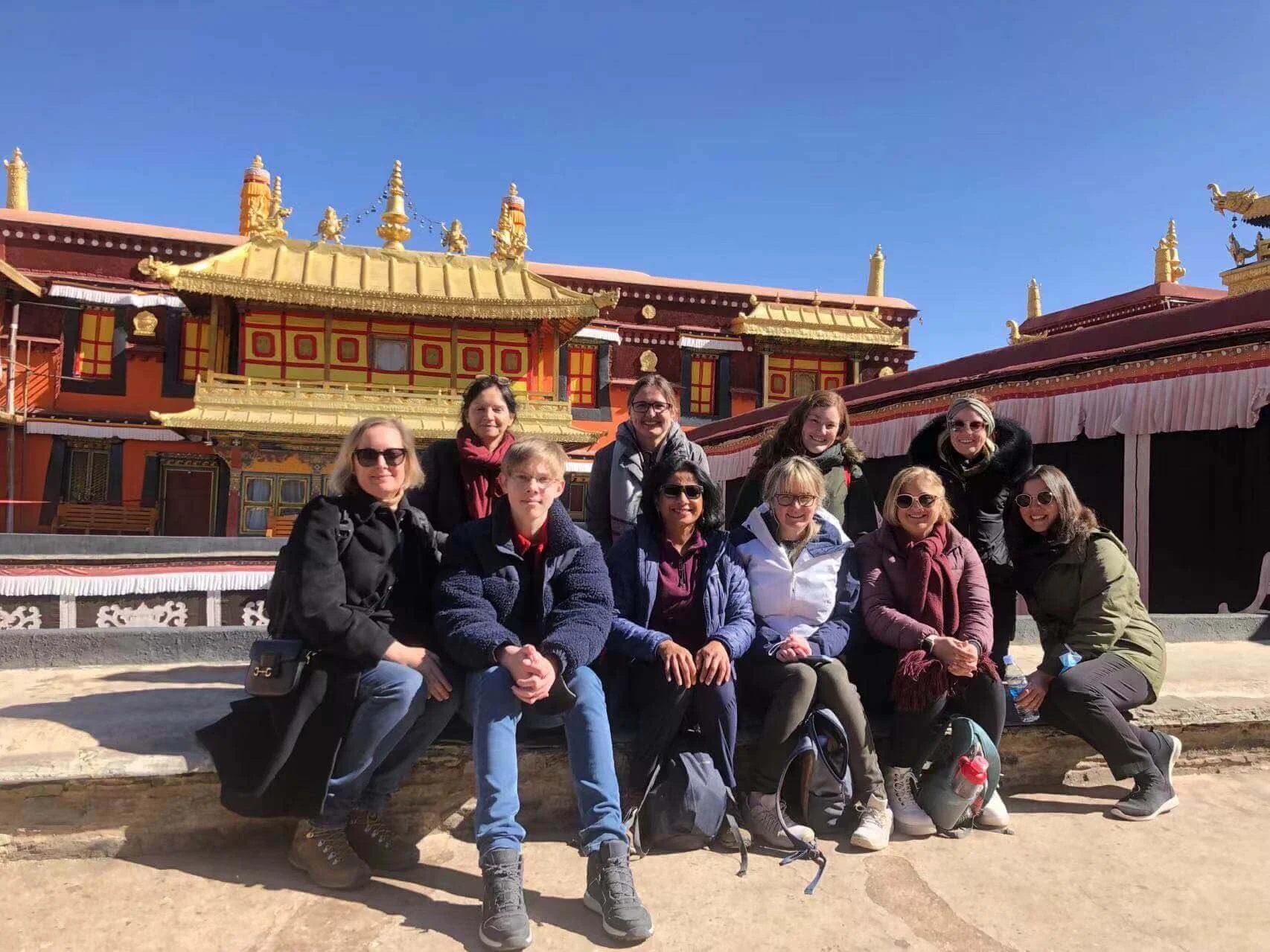
Experience Tibet has over 15 years of expertise in organizing tours throughout Tibet, Nepal and Bhutan. That’s not a marketing claim — it’s the reason their permits get approved, their guides know the back roads, and their travelers come back with stories instead of complaints.
Groups are designed with careful attention to dynamics, and guides keep the mood positive and lively. Small groups (typically 4–13 participants) mean you’re not lost in a crowd — you’re traveling with a handful of like-minded people who chose this trip for the same reasons you did.
What sets Experience Tibet apart:
- ✅ TripAdvisor Travelers’ Choice Awards 2025 — independently verified by real travelers
- ✅ All permits handled — Tibet Travel Permit + Bhutan visa + Bhutan SDF, all managed for you
- ✅ 15+ years on the ground — established relationships with local authorities that matter when it comes to permit approvals
- ✅ English-speaking local guides — not call-center reps but actual specialists with deep cultural knowledge
- ✅ Small groups — 4 to 13 participants maximum
- ✅ Direct communication — WhatsApp +86 15828535300 · WeChat: experiencetibettour · info@experiencetibet.org
- ✅ Simple and fast booking process — choose a tour, a starting date, and let the team do the rest, at their best price guaranteed
Frequently Asked Questions
Q: Do I need a Tibet Travel Permit for a Nepal Tibet Bhutan tour?
Yes — all foreign travelers visiting Tibet must obtain the Tibet Travel Permit in addition to their China visa or eligible exemption. Entry without the permit is strictly prohibited. Experience Tibet manages this for all Tibet tour bookings. Apply here →
Q: Can I do Tibet, Nepal and Bhutan without joining a group?
Solo independent travel in Tibet is not permitted for foreign visitors — you must travel with a licensed guide and agency. Nepal can be visited independently, but for a seamless combined itinerary, joining Experience Tibet’s small-group tour is by far the most practical and cost-effective option.
Q: What is the cheapest way to combine Tibet and Nepal?
The 4-Day Lhasa Holy City Tour starts from US$486 , making it the most accessible entry point for a Tibet experience. Combined with the 7-Day Tibet to Nepal Overland Tour, you get a complete Tibet-Nepal journey at a competitive price.
Q: Is the Tibet Nepal Bhutan tour suitable for first-time travelers?
Yes — especially with Experience Tibet’s fully guided, permit-managed packages. The key preparation is physical fitness for altitude (Lhasa is at 3,650m, Everest Base Camp approaches 5,200m) and allowing proper acclimatization time in your itinerary. Experience Tibet’s team provides guidance on altitude preparation before your trip.
Q: How far in advance should I book?
It is recommended to apply for the Tibet Travel Permit at least 15–20 days before your planned travel date. For the 16-Day Trans-Himalayan Tour — especially during peak seasons (April–May and September–October) — booking 2–3 months in advance is strongly recommended to secure your spot and allow time for all three permit processes.
Q: How do I start booking with Experience Tibet?
Contact the team directly: WhatsApp or Tel +86 15828535300 · WeChat: experiencetibettour · Email: info@experiencetibet.org. Or browse and reserve directly on the tour pages linked throughout this guide.
Ready to Begin Your Trans-Himalayan Journey?
Three kingdoms. Three cultures. One extraordinary spine of mountains that has shaped human civilization for thousands of years.
Whether you have a week for the overland crossing between Tibet and Nepal, or 16 days for the complete Trans-Himalayan circuit, Experience Tibet’s team has the local expertise, the permit authorization, and the 15 years of experience to make it happen — without the stress, and with all the moments that make this region unforgettable.
Choose Your Tibet Nepal Bhutan Tour:
| Tour | Duration | Price From |
|---|---|---|
| 🔗 7-Day Tibet to Nepal Overland Tour | 7 days | US$957 |
| 🔗 8-Day Himalayan Tour from Nepal to Tibet | 8 days | US$1037 |
| 🔗 4-Day Lhasa Holy City Tour | 4 days | US$486 |
| 🔗 8-Day Nepal Tour: Kathmandu, Chitwan & Pokhara | 8 days | US$1099 |
| 🔗 16-Day Tibet, Nepal & Bhutan Trans-Himalayan Tour ⭐ | 16 days | US$3,270 |
📞 Contact Experience Tibet: WhatsApp +86 15828535300 · WeChat: experiencetibettour · info@experiencetibet.org